The Boulevard That Splits La Verne's Housing Market in Two
September 3, 2026
September 3, 2026
Ask what happened to home prices in La Verne this year and you'll get answers that don't agree with each other. One reading puts the median up more than 25 percent year over year. Another puts it up closer to 12 percent. A third shows it essentially flat. A fourth shows it down double digits. Days on market ranges from three weeks to more than two months, depending on which count you trust. These aren't rounding differences. They're describing what sounds like different cities.
They are, in a sense, describing different cities. La Verne's housing stock splits along Foothill Boulevard into two markets that behave nothing alike, and the reason the headline number keeps changing isn't that prices are swinging wildly month to month. It's that so few homes close here in any given stretch that the mix of what sold, not what buyers paid for it, is doing most of the work.
Start with the clearest data set available: county-derived sales figures covering the first quarter of 2026. In that quarter, La Verne recorded 46 closed home sales, a drop of 20.7 percent from the same period a year earlier. The median sale price across those 46 transactions came in at $887,000, up 12.4 percent year over year. Price per square foot moved only 1.7 percent in the same window.
Here's the detail that actually explains the confusion. When you separate that quarter's sales by property type, single-family homes had a median of $925,000, showing no meaningful change year over year. Condos told a completely different story: their median fell 31.1 percent to $475,000.
Two numbers moving in opposite directions, folded into one headline figure, produce a citywide median that looks like it jumped 12 percent when the actual home prices underneath it barely budged. What changed wasn't what buyers were willing to pay. What changed was the ratio of houses to condos that happened to close that quarter. Pull a few more condos into the mix and the blended median drops. Pull a few more single-family sales into the mix and it climbs. With only 46 transactions total, a handful of closings in either direction can swing the composite by six figures without a single seller changing their price.
That pattern has continued through the middle of 2026. Readings taken over the summer show single-family price-per-square-foot changes ranging from a small increase to a decline of roughly 5 percent depending on the source and the exact months compared, while median days on market has been reported anywhere from the low 20s to the high 70s. None of these readings are wrong. They're measuring a market thin enough that the sample changes the story.
The reason the mix keeps shifting has a physical explanation, and it runs right through the middle of town. Foothill Boulevard divides La Verne into two housing markets with almost nothing in common except a shared zip code.
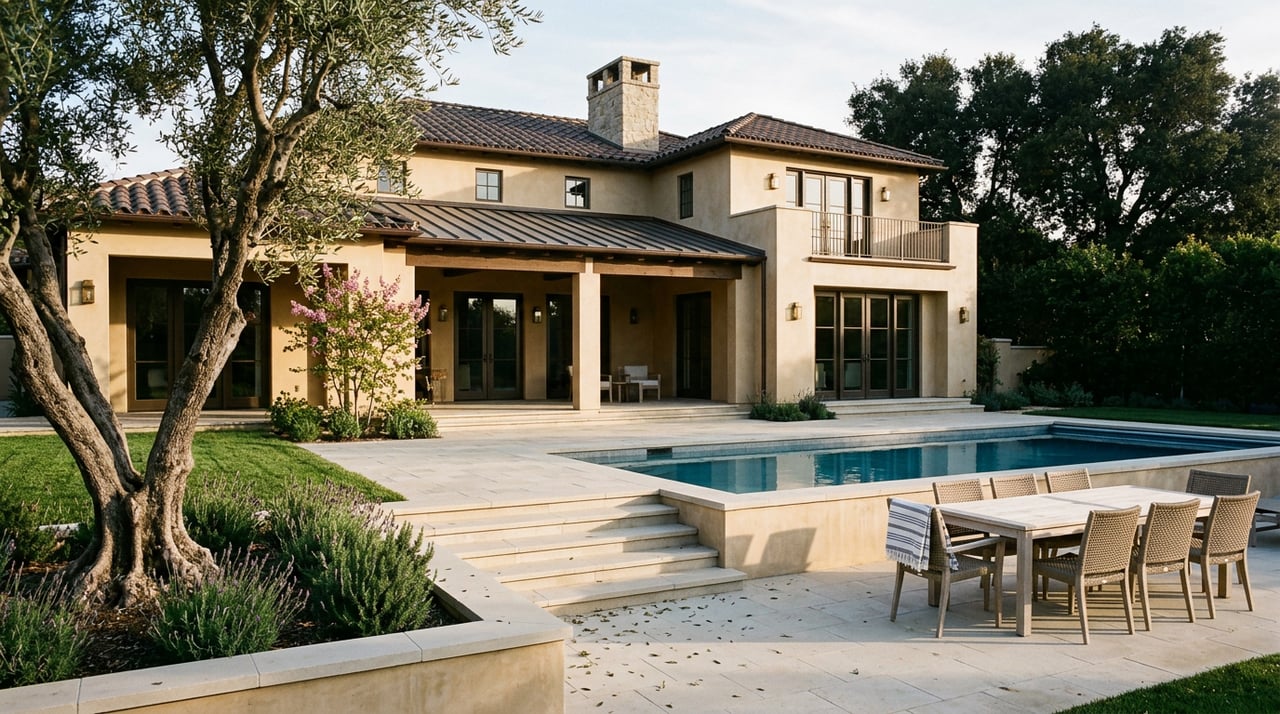
North of Foothill sits the foothill pocket: larger lots, later construction, more custom-built homes, and the kind of land use that comes with proximity to open space. Marshall Canyon Golf Course, an 18-hole public course built into the hillside in 1966 and owned by Los Angeles County, sits at 6100 N. Stephens Ranch Road along this edge of the city. Next to it, the 119-acre Marshall Canyon Regional Park offers forty campsites, an equestrian center with individual horse corrals, and trail access into the foothills. Homes built near this amenity base tend to be newer, sit on bigger parcels, and price accordingly.
South of Foothill is a different housing stock entirely: smaller lots, older construction, and a walkable core built around Old Town La Verne and the University of La Verne campus. Bungalows from the 1930s sit alongside postwar infill. Buyers here are typically paying for walkability, character, and land use efficiency rather than square footage or a view. This is also where most of the city's condo inventory sits, the same inventory that pulled the composite median down by nearly a third in the first quarter of the year.
| North of Foothill Boulevard | South of Foothill Boulevard | |
|---|---|---|
| Housing stock | Larger lots, later-era custom builds | Smaller lots, prewar and postwar bungalows |
| Nearby amenities | Marshall Canyon Golf Course, Marshall Canyon Regional Park | Old Town La Verne, University of La Verne |
| Property mix | Mostly detached single-family | Mix includes most of the city's condo inventory |
| What buyers are paying for | Land, newer construction, foothill access | Walkability, character, land use efficiency |
Neither side is more or less desirable than the other. They serve different buyers with different priorities. But when a data provider reports "La Verne's median," it is quietly averaging across both, and the weight each side carries in that average depends entirely on which homes happened to close that month.
To see how sensitive this is, imagine two versions of the same month. In one, three custom homes near Marshall Canyon close alongside a typical run of Old Town bungalow sales. In the other, those same Old Town sales close alongside two condo transactions instead of the foothill homes. Nothing about buyer demand or home values needs to change between those two scenarios. The reported median still moves substantially, because the median is a function of which nine or ten transactions cleared escrow, not a temperature reading on the market as a whole.
This is why a city closing under 50 single-family transactions in a quarter cannot be read the same way a larger, more liquid market can. In a market with thousands of quarterly sales, one Tuesday's closings barely move the average. In La Verne, one week's closings can be a meaningful share of the entire quarter's data.
If you're weighing La Verne against Claremont, Upland, or Glendora using citywide medians pulled from a portal, you're comparing numbers that carry very different amounts of statistical noise depending on how many homes each city actually sells. The fix isn't to distrust the data. It's to stop treating the citywide print as the answer and start treating it as a starting point.
A few practical habits follow from this:
None of this means La Verne is an unpredictable place to buy or sell. It means the citywide number is a compressed version of two stories, and the useful information lives in knowing which story applies to the specific street, lot, and property type you're actually considering.
Is La Verne's housing market up or down in 2026? Depending on the measure and the months compared, you'll find readings showing gains, readings showing flat prices, and readings showing declines, often for the same general period. The honest answer is that the citywide figure moves with the mix of what sold, not with a single clear trend in either direction.
Why did condo prices drop so much more than house prices? Condo sales make up a small share of total transactions in La Verne, so a few lower-priced closings can pull that category's median down sharply without reflecting a broader shift in value. The first quarter of 2026 saw condo medians fall 31.1 percent year over year while single-family medians held essentially flat.
Does living north or south of Foothill Boulevard actually change what a home is worth? It changes what you're paying for. North of Foothill tends to mean larger lots and newer construction near Marshall Canyon Golf Course and Marshall Canyon Regional Park. South of Foothill means smaller, older homes within walking distance of Old Town and the University of La Verne. Comparable sales should come from the same side of that line whenever possible.
If you're trying to figure out what your budget actually buys on either side of Foothill Boulevard, that's a conversation worth having with someone who pulls the pocket-level comps instead of the citywide print. Lisa Warshaw puts together that kind of analysis for buyers and sellers across La Verne and the surrounding foothill communities. Schedule a free concierge consultation to talk through what the numbers mean for your specific street.
From start to finish, Lisa brings personalized service, powerful advocacy, and proven systems to help you reach your real estate goals.